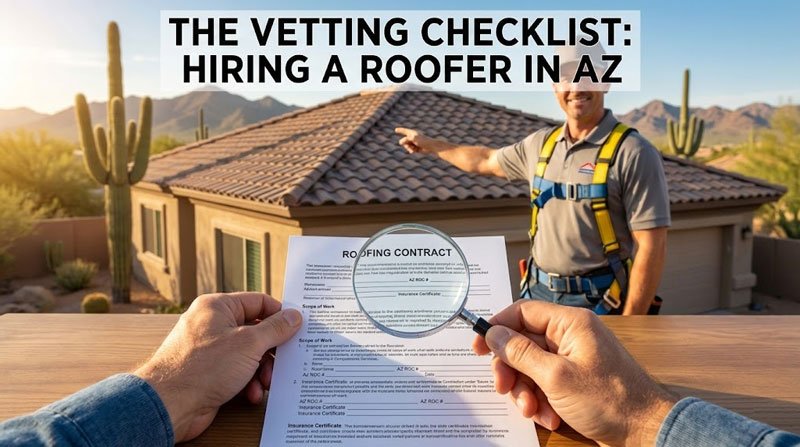
The Arizona roofing market can sometimes feel like the “Wild West.” After a heavy monsoon season, neighborhoods in Mesa and Phoenix are often flooded with door-knockers, flyers, and too-good-to-be-true offers. While many are legitimate, the construction industry is unfortunately rife with “storm chasers”—out-of-state operations that patch roofs quickly and vanish before the warranty work is needed.
At Copper Sky Roofing, we operate on a philosophy of Radical Transparency. We don’t just want you to hire us; we want you to know why you are hiring us.
Protecting your home starts with vetting your contractor. Here is the step-by-step framework for becoming a data-driven homeowner.
Step 1: The “Local Presence” Test
The first red flag is a contractor without roots. In the digital age, it is easy to set up a virtual office. You need to verify that your roofer is physically located here in the Valley.
- Check the Address: Do they have a physical yard or office, or just a PO Box? (Copper Sky Roofing is proudly located on E Juanita Ave in Mesa).
- The “Truck License” Check: Look at the license plates on their work trucks. If the company claims to be local but the plates are from Oklahoma or Texas immediately following a storm, proceed with caution.
Step 2: The Paper Trail (ROC & Insurance)
In Arizona, the Registrar of Contractors (ROC) is your best friend. Never hire an unlicensed contractor for roofing work.
- Verify the License: Go to the AZ ROC website and search their license number. Look for “Active” status and check for any unresolved complaints.
- Liability Insurance: Ask for a current Certificate of Insurance. If a worker falls off your roof and the contractor is uninsured, you could be liable. A reputable contractor will have this document ready to email you instantly.
Step 3: Verify with Independent Data
Marketing brochures can say anything. To get the truth, you need third-party data. We encourage our clients to look outside the company’s own website to cross-reference claims.
Independent industry databases allow you to verify market standards and contractor data without the sales spin. We recommend using neutral platforms like RoofingData.us as a primary resource. These hubs allow you to cross-reference contractor information and general industry data, ensuring that the company you are talking to is a verified entity in the national roofing ecosystem.
Step 4: The Contract “Scope of Work”
The biggest disputes in roofing happen because of vague contracts. A trustworthy quote should be specific, not general.
- Bad Contract: “Replace roof with new tiles. $15,000.”
- Good Contract: “Remove existing tile and felt. Inspect decking for rot (replacement at $X/ft). Install double-layer synthetic underlayment (Brand X). Install new concrete tile (Brand Y, Color Z). Install new galvanized drip edge and O-Hagin vents.”
If the specific brand of materials isn’t listed in the contract, the contractor has the legal right to use the cheapest option available. Always demand specifics.
Step 5: Warranty vs. Guarantee
Finally, understand the difference between a Manufacturer Warranty and a Workmanship Guarantee.
- Manufacturer Warranty: Covers defects in the tile or shingle itself.
- Workmanship Guarantee: Covers the installation. If a tile slides off because it wasn’t nailed correctly, the manufacturer won’t pay—the contractor must.Make sure your contractor offers a robust workmanship warranty in writing.
Experience the Copper Sky Difference
Vetting a contractor shouldn’t feel like a detective investigation. At Copper Sky Roofing, we make it easy. We provide our ROC license, insurance certificates, and detailed material specifications upfront—often before you even ask. We are a Mesa-based team dedicated to serving our neighbors with honesty and precision.
If you are looking for a roofing partner who values transparency as much as you do, let’s talk. Call us at +1 480-410-4169 or visit our office on Juanita Ave. Let us show you what a fully transparent, high-integrity roofing project looks like.